The Tritone – The devil’s interval
The tritone is a specific interval of 6 half steps. This interval has some interesting properties, so interesting in fact that it was banned in music by the Catholic Church for hundreds of years. It was known as the devil’s interval.
The tritone is a half step below the perfect fifth, the most euphonic of intervals and the most natural at the half division of the octave. Being just below the fifth provides a different kind of dissonance, not quite are raw as that of the minor second, but equally innerving when the two notes are played in unison, something about it is just not quite comfortable.
The most interesting property of the tritone is how we perceive it. When a tritone is played within one octave, each listener is subject to hear it differently. When it is used within the confines of a piece of music, the context in which it is used masks this, however taken on its own and free of neighboring notes, some will hear the interval ascending, others descending.
There is no known reason for this however there is one widely accepted theory that explains several other interesting things discovered while investigating the tritone. We find that while each person hears the interval differently, they all hear it consistently and predictably. In one subject, F # to C may be perceived as falling and F to C# as rising, but almost always the same way.
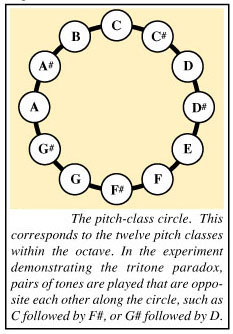 The most widespread theory explaining this phenomenon is how the brain organizes the perception of musical notes.
 The chart to the right shows a circle containing the 12 musical pitches, think of it as you see it on the screen, vertically with a top an a bottom geographically speaking. At this specific orientation of the wheel, the jump of C to F# would require dropping straight down the wheel, where going from F to B would be climbing right up. These intervals are always perceived this way. What about going from A to D#? There is no sideways in music, only up or down, and this is where we become confused. We are uncertain whether the note rises or falls because in the wheel, it does neither.
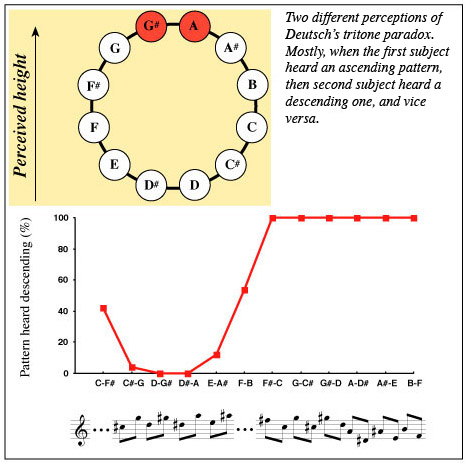
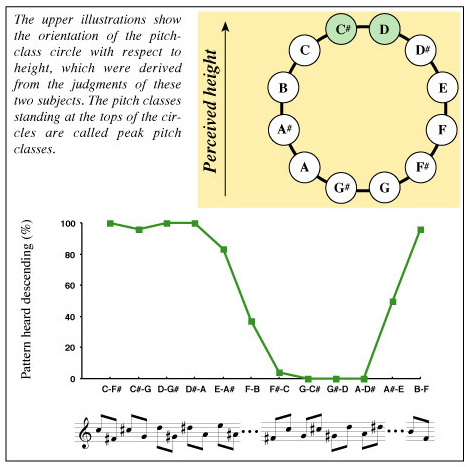
Below you will see two charts depicting how two different subjects hear an octave of tritones. If you look at the data, you will see it lines up perfectly with the explanation provided by the wheel theory above.
All charts taken from
- http://deutsch.ucsd.edu/psychology/pages.php?i=206

No comments:
Post a Comment