Auditory illusions
An illusion is something that manipulates ones perception. Many of us are familiar with optical illusions, seeing things moving that really sit still, colors that are not there, images that seem to make sense but on further inspection would be impossible. This results from our brain’s desire to find patterns in everything. This is true with our perception of sound just as much as with vision. This phenomenon is called auditory apophenia. Our brains are wired to find order, to see patterns, to draw meaning from every stimulus we encounter. We hear words and phrases where there is only random sound, we hear melodies in the chaos of what should be discord. Our ears can be tricked into hearing pitches in any manner of ways, infinitely ascending, moving up or down depending on the listener.
All of this is the result of our attempts to organize the world. One incredible phenomenon that shows just how strongly we are preconditioned to hear and decipher language is called the phantom voice effect. When we are presented with a repeating series of nonsense syllables our brains strive to find meaning in them, they will begin to piece together bits of what they hear and paste them with bits of what we know to form something discernable. A common sound used is the repeating syllables ba-ma- ba-ma- ba-ma- ba-ma- ba-ma- ba-ma-… Each person will hear something different, in their own dominant language. A comic book fan might hear “Bat Man Bat Man Bat Man,” an alcoholic might hear, “Bar Maid Bar Maid Bar Maid,” and so on. This is a common explanation provided for people who attest to hear the “voices” of ghosts in recordings or in their homes. We hear what we want to hear, or fear we will hear.
Another fascinating phenomenon dealing in musical pitches is called the Shepherd’s Tone. This is an illusion named after Roger Shepherd who first created the idea and rough theory; it was then perfected by Jean-Claude Risset, who refined it to the perfect illusion we have now. The effect of the illusion is a continuously climbing scale that never stops rising or falling. To picture how this works, consider a brass trio consisting of a trumpet, a horn, and a tuba. They all start to play a repeating C scale (C–D–E–F–G–A–B–C) in their respective ranges, i.e. they all start playing Cs, but their notes are all in different octaves. When they reach the G of the scale, the trumpet drops down an octave, but the horn and tuba continue climbing. They're all still playing the same pitch class, but at different octaves. When they reach the B, the horn similarly drops down an octave, but the trumpet and tuba continue to climb, and when they get to what would be the second D of the scale, the tuba drops down to repeat the last seven notes of the scale. So no instrument ever exceeds an octave range, and essentially keeps playing exactly the same seven notes over and over again. But because two of the instruments are always "covering" the one that drops down an octave, it seems that the scale never stops rising.
Friday, March 2, 2012

Thursday, February 23, 2012
Tritone
The Tritone – The devil’s interval
The tritone is a specific interval of 6 half steps. This interval has some interesting properties, so interesting in fact that it was banned in music by the Catholic Church for hundreds of years. It was known as the devil’s interval.
The tritone is a half step below the perfect fifth, the most euphonic of intervals and the most natural at the half division of the octave. Being just below the fifth provides a different kind of dissonance, not quite are raw as that of the minor second, but equally innerving when the two notes are played in unison, something about it is just not quite comfortable.
The most interesting property of the tritone is how we perceive it. When a tritone is played within one octave, each listener is subject to hear it differently. When it is used within the confines of a piece of music, the context in which it is used masks this, however taken on its own and free of neighboring notes, some will hear the interval ascending, others descending.
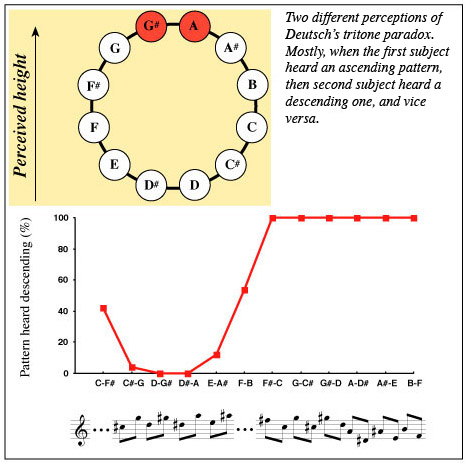
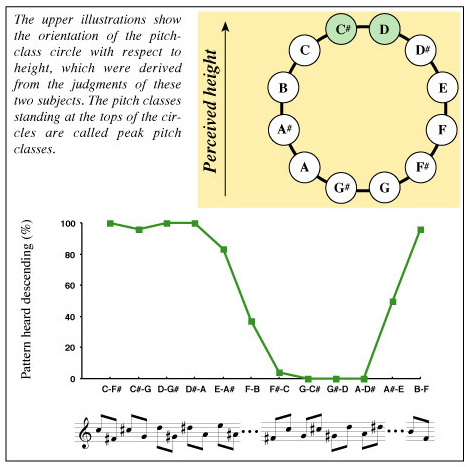
There is no known reason for this however there is one widely accepted theory that explains several other interesting things discovered while investigating the tritone. We find that while each person hears the interval differently, they all hear it consistently and predictably. In one subject, F # to C may be perceived as falling and F to C# as rising, but almost always the same way.
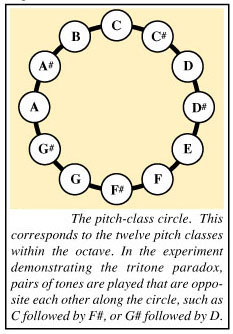 The most widespread theory explaining this phenomenon is how the brain organizes the perception of musical notes.
 The chart to the right shows a circle containing the 12 musical pitches, think of it as you see it on the screen, vertically with a top an a bottom geographically speaking. At this specific orientation of the wheel, the jump of C to F# would require dropping straight down the wheel, where going from F to B would be climbing right up. These intervals are always perceived this way. What about going from A to D#? There is no sideways in music, only up or down, and this is where we become confused. We are uncertain whether the note rises or falls because in the wheel, it does neither.
Below you will see two charts depicting how two different subjects hear an octave of tritones. If you look at the data, you will see it lines up perfectly with the explanation provided by the wheel theory above.
All charts taken from
- http://deutsch.ucsd.edu/psychology/pages.php?i=206
Thursday, February 16, 2012
Glory Road
This week in Project Based Science we took some time to talk about black history month and watch the film Glory road, we were given some questions to respond to as a part of the assignment, these are my responses
Glory road is set during the peak of the civil rights movement, what situations in the movie stood out to you as being very different from how people are treated today?
1
Much from this time period is different; I think the most clear example of which is the player being beaten in the bathroom simply because of his skin’s melanin concentration. Animosity still exist, I won’t try and deny that, however it is no longer socially acceptable. It is held privately and cannot be openly stated. This throws an interesting dynamic on the issue. Despite what people may feel, they cannot simply flaunt it openly, they will be judged, and the justice system has come leaps and bounds forward in offering blacks the same protection as their white counterparts. That said violence like this is not what it was.
Coach Don Haskins and the team members are challenged to confirm their core beliefs and values, and to stand up for what they know is right, have you ever stood up for something you know is right?
2
Note - Names have been changed to protect the innocent
The most significant example from my recent life in standing up for what I believe is right against opposition is the story of Gustavo Albertson. I have known Gustavo since the 6th grade, he was for quite some time one of my best friends. He is a brilliant individual, rife with potential, but lacking in motivation. Because of this, he has made some very poor decisions over the years. After dropping out of high school to attend CC, and sequentially dropping out of CC, his life spiraled into a terrible cycle of drug use, physical and emotional abuse of those close to him, and very poor hygiene. He was dating a girl, Kathryn. Victoria was homeless before she met Taylor, and was soon living with him. I met her while hanging out with Gustavo on one of his better days. Things went well with them for some time, however soon they began to deteriorate. Gustavo became constantly angry, lashing out it fits of verbal and sometime physical abuse. He became incredibly paranoid of the slightest things, jealous of any contact she had with the outside world, not an hour going by without brash accusations of infidelity and treachery. I saw what was happening to Taylor, as he was decaying, and what he was doing to Kathryn. I could not permit that to go on any longer, I began to interfere. I talked to them both, trying to get Victoria to see what she was doing to herself by staying with him, trying to get Gustavo to see what he was doing to her. After ages of discontented stagnancy, one particularly large fight lead to their first “break up” for a few days I could see Victoria happy for the first time since the first day I had met her, soon they went back to each other, again unhappy, again in frequent, violent outbursts daily. I began to interfere more, eventually splitting them up. I know many people may think it was not my place to dabble in other peoples affairs. However I know that I could not sit idly by and watch two people that I love destroy each other. Abuse is one thing I simply can not condone; anyone who would sit by and just allow this destruction to go on is nothing more than a coward. Now that they are broken up I have never seen Victoria happier, she is becoming the person she used to be, she is pulling away from her addictions that she used to use as a crutch against the mess her life used to be, she is working, and she is back in favor with her family who had previously ostracized her. To do this, I had to jeopardize one of my longest standing friendships, Gustavo has not forgiven me, I don’t know if he ever will, but the person he is now is not the friend I used to hold, and not a person I can wrap myself up in.
In your opinion, why is the story behind glory road such an important story to tell?
3
The story of the movie glory road tells about the struggle for acceptance of a group of black students in a predominantly white world of basketball at the time. Nothing had ever been done before anywhere near the extent of what they did. By winning the national championships they showed the nation that blacks were just as capable on the court as whites, and in this case, even better. Their fight was not simply for a trophy, but for the standing of their race. This was an important battle to fight. Because this story is more than just a basketball game, because of what it represented for the black community and for Division 1 basketball, it is worth telling. This story is still relevant today as a reminder of what we came from, where we are going to, and what it took to get where we are today as a society.
Friday, February 10, 2012
Conductive Deafness
Conductive Deafness
Conductive deafness is a form of hearing loss resulting from vibrations being unable to reach the receptors of the cochlea. Many of us have experienced this at some point for some short length of time.
The most common form of conductive deafness is due to a buildup of cerumen, or earwax in the auditory canal. If this build up spans the entire breadth of the auditory canal, this can cause temporary loss of hearing in the effected ear. In most cases the blockage will pass with time, however in more severe cases removal may be necessary. Also common are external ear infections which can similar blockages of the auditory canal. Less common are other causes such as tumors, “surfers ear” (exostosis within the auditory canal) and
Conductive deafness can also result from problems with the tympanic membrane; perforation is a common form of this. Trauma, explosions, ridiculously loud noises or sever pressure changes all can result in ear drum perforation. In most cases the tympanic membrane will heal reasonably quickly, taking on average about a week. In some cases however surgical intervention may be necessary. After healing hearing will most likely return to fully normal. Dramatic pressure changes that are not quickly equalized can result in a temporary loss in hearing sensitivity as the tympanic membrane is pulled much tauter than usual and unable to freely vibrate.
In the middle ear fluid accumulation is a common form of conductive deafness, usually caused by some form of infection. This accumulation prevents the free movement of the ossicles and tympanic membrane drastically reducing hearing conductivity.
In most cases conductive deafness is treated easily, in the event of infections with antibiotics, blockages with removal, and in some cases, a special hearing aid designed to bypass the problem if it can not be safely removed.
Tuesday, January 31, 2012
Hearing Disabilities – Sensoryneural Deafness
Hearing Disabilities – Sensoryneural Deafness
Sensoryneural deafness is the most commonly encountered form of hearing disability. It is defined as the loss of response to a specific range of frequencies due to damage to or defect with the inner ear. It can be mild and go almost unnoticed unless looked for, or it can be debilitating in more severe cases.
Sensoryneural hearing loss is the much more severe form of hearing loss, as it can not be treated. It involves damage to the hair cell receptors for sound in the inner ear.
Almost all adolescents and older suffer from this form of deafness, however this is not within the range of frequencies normally encountered, and goes totally unnoticed. The highest frequencies are easily lost though what is now natural background noise. Humans are now exposed to much more damaging acoustic activity than we once were, we now have some form of noise almost constantly, even lying in bed there is the hum of a machine in the next room, the creaking of the house, the drone of traffic. This constant noise is not something we are biologically adapted for as it rarely occurs in nature. We also deal with much louder sounds than ever before. A single rock concert today puts out more sound energy in a few hours than earlier humans may have encountered in a full lifespan. All of this leads to far more stress than the ear is designed to take. This said, more and more people are suffering from progressive deafness.
The highest frequency receptors in the cochlea are the first to go, as they are the most sensitive. Through further abuse, a wider range of hearing is lost. Now by the later years of one life it is not unheard of for an individual to suffer from hearing loss severe enough to require treatment. When the frequency range that is required to carry on regular day to day activities is lost, it becomes a problem. Conversation may be difficult, slow due to poor clarity of signals being sent to the brain. The problem is frequency however more than volume, this is why an elder member of the family may be able to understand some people better than others, their voice falls into the frequency ranges that are better processed by the elder.
Those that have had greater trauma suffer more drastic and notably faster loss. Occupational hazards such as the drone of loud machinery in a factory, the extreme volume levels musicians are now subjected to, or the frequent loud bursts suffered by an artillery soldier have clear and terrible consequences on the inner ear.
Friday, January 27, 2012
Music Therapy –
Music Therapy –
Music therapy is a relatively new form of treatment in the medical field. Some consider it a pseudo science; however numerous trials have shown the field to be an effective supplement to traditional care. Music therapy does not claim to singularly cure any form of disease or disorder, however its primary concern is alleviation some symptoms and aiding in the overall comfort of the patient. Music therapy has been shown in trials to help in treatment of high systolic blood pressure, aggregated heartbeat, general stress, minor chronic pain, depression, and sleeplessness. Music therapy has even been shown the help slow and even reverse some memory damage in patients suffering form Alzheimer’s through the “Kenny-Rodger’s” effect.
Music therapy, or at the very least its unrefined cousin, has been used widely in many cultures throughout history. Native Americans and many other cultures have used chanting and drumming in healing rituals for centuries. The ancient Greeks viewed music as a force capable of healing and aiding the both the soul and body. As far back as biblical times, we read about David playing the harp to ease King Saul of his bad sprits. Even if we do not accept the bible as a reliable historical source, its contents reflect the culture of the time, and show that music was used for such purposes. The first official and scientific applications of music therapy came late in World War II. Music was used to treat shell shock victims with great success, a treatment that is still in use today. (Though shell shock has become known as Post Traumatic Stress Disorder)
Many colleges are now offering full degrees in the subject of music therapy, the first being Michigan State University in 1944. Now there are 77 different colleges offering formal degrees in music therapy accredited by the American Music Therapy Association. (An organization founded by a collective of practicing therapists to promote research and common, safe practice standards.)
The overall goal of music therapy is to treat a psychological element to the patients ailments, thereby translating to alleviation of physical issues just as any other form of psychological therapy functions.
There are a wide array of methods used, each individual to the patient being considered. Listening to music, talking about it, creating it, even composing are all widely practiced methods.
Sources :
Friday, January 20, 2012
Dissonance
"An unstable tone combination is a dissonance; its tension demands an onward motion to a stable chord. Thus dissonant chords are 'active'; traditionally they have been considered harsh and have expressed pain, grief, and conflict."
—Roger Kamien (2008),
Dissonance is the musical term for any form of unstable and usually unpleasant sounding intervals, chords, or sounds occurring within music. Dissonance creates tension and stress (usually) to be relieved though resolution.
Dissonance is perceived in two ways, one is measurable and rooted in our physiology; the second is a product of musical training. The one of the structures of the inner ear that allows us to hear as we do is the cochlea. Within the cochlea are numerous specialized hair-like structures organized in groups that respond best to specific frequencies. The grating and jarring dissonance that arises from very close intervals such as a minor second result from the two frequencies overlapping the areas of the cochlea they stimulate. This creates an unpleasant sound due to the tangled singles the brain is receiving due to this overlap.
The second form of dissonance is cultured, trained within each of us. As we listen to the music of our cultures, our brain organizes certain rules. These rules are expected to be followed, and when they are broken, or when what we have anticipated does not happen, we experience discomfort. Imagine watching a basketball game. All is going as normal when suddenly a player pulls the ball to his chest and sprints across the court without dribbling. People create an uproar over the foul they have just seen. The rules they have been conditioned to follow, and have come to expect others to observe as well, have just been broken. If a man who had never seen or heard of this sport were to see the same thing, he would likely think nothing less of the traveling player, if anything he would find him clever for trying a new solution to the problem of getting the ball across the court. This is the same thing we experience when we hear an unresolved chord, a suspension gone awry, when a player steps out of the set key, disrupting the harmony. They are products of culture, of our cultivated expectations for music. Most people do not know the rules; however they have listened to enough music to know when something is not right, just as an armature spectator may not know the terms for each foul, or know the hand signals used by the referee; however they can still know when someone has broken the rules.
Dissonance can be used to convey negative emotion, tension, anger, discomfort, whatever the composer may need. It is often used as a spice to a specific musical moment; however some genres use dissonance as their defining aspects. Some heavy metal and hardcore groups us dissonance to add to the ambient sense of anger, toughness, or evilness of some music. In any case, dissonance is manipulated to strengthen the emotional contours of music and draw the audience in to the music.
Subscribe to:
Comments (Atom)